
 Bridgewater Transit
 Energize Bridgewater
 eServices Account Login and eBilling
  Clean Energy Financing Program
 Downtown & Waterfront Master Plan
  Bridgewater Active Transportation
  Community Organizations Directory
  Bridgewater Fire Department
 Discover Bridgewater's Built Heritage
  DesBrisay Museum
 Public Service Commission of Bridgewater
The Public Service Commission of Bridgewater (PSCB) is a separate corporate body, operating the water utility of the Town of Bridgewater, providing potable water for approximately 3,100 customers and the fire protection through hydrants and sprinkler services. Customers exist both in Town and beyond into the county.
Watershed Protected Area
BRIDGEWATER'S NEW SOURCE WATER PROTECTION PLAN
What is a Source Water Protection Plan?
A Source Water Protection Plan identifies potential risks and hazards to a municipal drinking water supply. The Plan outlines simple, straightforward, and proactive approaches to prevent drinking water problems from occurring. This will be achieved through the six different management options:
1. Acquisition of Land
2. Education and Stewardship
3. Best Management Practices (BMP)
4. Contingency Planning
5. Designation
6. Bylaws
Nova Scotia Environment has developed a multiple barrier approach with three lines of defense:
MAINTAIN clean source water by selecting the highest quality water source and protect it from contamination.
TREAT source water to remove natural and man-made impurities.
MONITOR source water quality consistently and take swift, corrective action when deficiencies are identified.
 How was the Plan developed? Who is involved?
In 2011, a Source Water Protection Advisory Committee was established, to assist the Public Service Commission of Bridgewater (PSCB) effectively manage and maintain a source water supply for the Town of Bridgewater and surrounding area.
The development of a Source Water Protection Plan is a requirement of the Utility's Approval to Operate from the Nova Scotia Environment.
The Source Water Protection Advisory Committee is comprised of:
- a member of the public who lives in the source water protection area
- a local representative from each of the agriculture, forestry and resource extraction
- a representative from the local environment interest group (the Coastal Action Foundation)
- a member of Bridgewater Town Council
- a member of the Municipality of the District of Lunenburg Council
- technical representatives from the PSCB
- a staff representative from the Municipality of the District of Lunenburg
- and representatives from each of the Nova Scotia Department of Natural Resources and Renewables, Nova Scotia Public Works, the federal Department of Fisheries and Oceans and Nova Scotia Environment.
What does the Source Water Protection Plan identify and propose?
The plan identifies and rates RISKS to the water supply. Risks are evaluated, on a priority ranking, based on how certain types of land uses and activities - or the location of uses and activities - may lead to potential issues in the drinking water supply. The plan also documents the "Management Options" that have either been completed or seen as part of a future implementation plan. Management Options is a general term used to describe what proposed response can be undertaken, involving the Public Service Commission, to reduce the potential risk in delivering safe drinking water.
What communities are included in the Source Water Protection Plan?
The plan covers the natural watershed, which is a much larger geographical area than is the designated protected area. The natural watershed includes the communities of Hebbville, Wileville, Newcombville, Lapland, Laconia, Waterloo, Camperdown, Hebbs Cross, and Chelsea - all land that drains or "sheds" water into the Petite Riviere. Within the natural watershed is the designated protected area, this area is covered by regulations under the Environment Act which allows a water utility to oversee regulated activities that may impair water quality within a source water supply area.
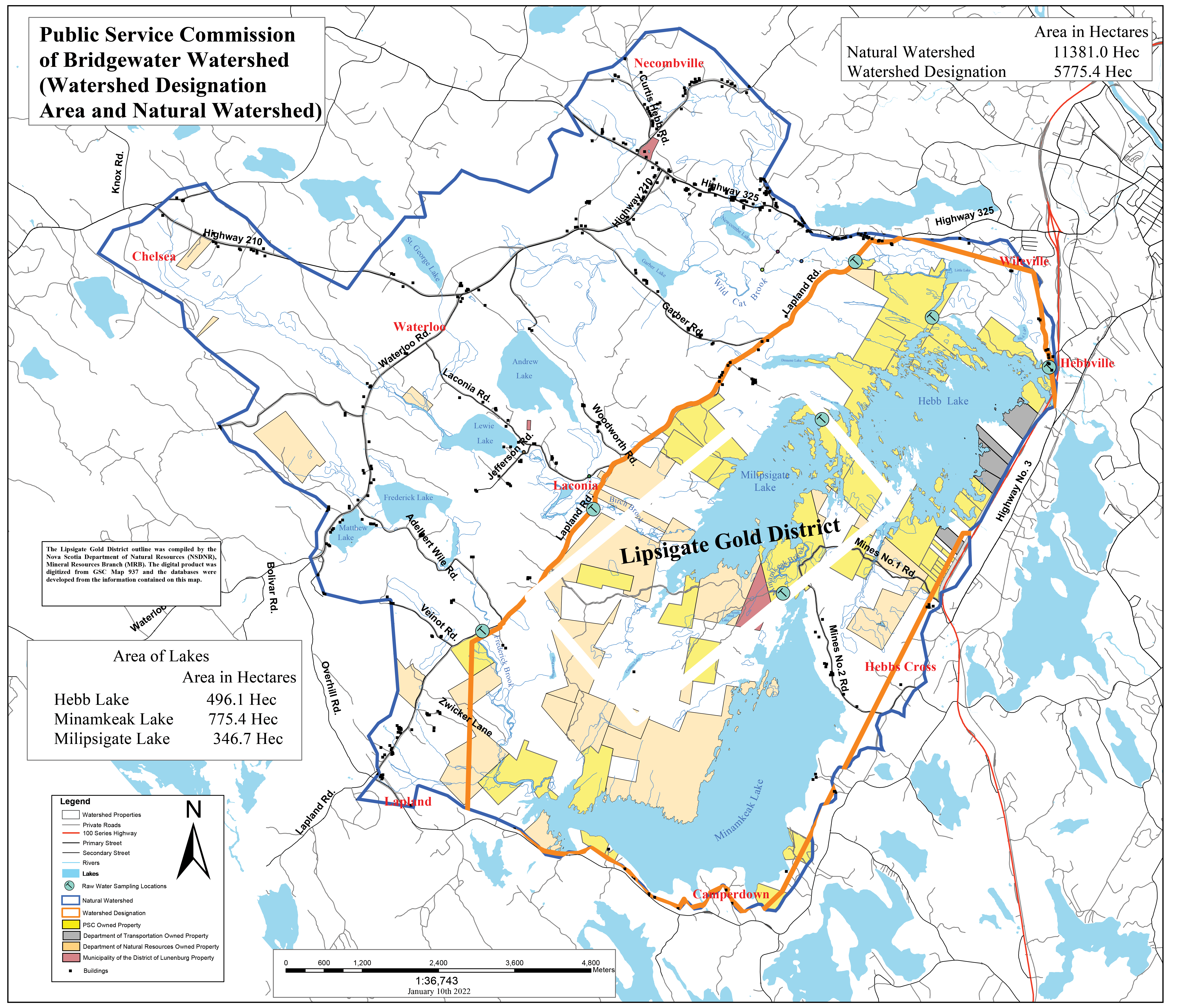
Regulations Respecting Activities in the Hebb, Milipsigate and Minamkeak Lake Watershed Protected Water Area
Restricted Activities
1. No person shall at any time in the year operate a motorized vehicle of any kind on, through, or over Hebb Lake and Milipsigate Lake, without first obtaining the permission of the Water Works Operator.
2. No person is permitted to swim, bathe,or wash in Hebb Lake.
3. No person is permitted to release or cause or permit the release of any substance that impairs water quality, including any of the following:
- oil
- petroleum products
- soap
- detergent
- toxic chemicals
- pest control product waste
- garbage
- litter
- solid or liquid waste
Other activities that are covered by the regulations include:
- Prohibition on landfills
- On-site sewage disposal
- Discharge of domestic sanitary waste
- Forestry operations
- Agriculture
- Pest control products
- Erosion and sediment control
- Pits and quarries
- Stormwater management
- Mining Activities
Permits and approvals
For greater certainty all activities within the Protected Water Area must be conducted in accordance with the Environment Act and regulations, including any requests for approvals.
For a complete copy of the Regulations Respecting Activities in the Hebb, Milipsigate and Minamkeak Lake Watershed Protected Water Area made by the Minister of Environment and Labour please visit: https://www.bridgewater.ca/images/documents/watershed_protected_area_schedule_b.pdf.
If you notice any of the listed activities, please contact: PSCB at (902) 543-5142 or Nova Scotia Environment at 1-800-565-1633.
For illegal dumping concerns please contact:
Lunenburg Community Recycling Center - (902) 543-2991
Justin Cleveland (Compliance Officer) - (902) 543-4277 or e-mail
For further information about the Source Water Protection Plan, please contact:
Public Service Commission of Bridgewater
c/o Justin Penny
60 Pleasant St., Bridgewater, NS B4V 3X9
HISTORICAL BACKGROUND
PUBLIC NOTICE CONCERNING NEW DESIGNATION OF THE HEBB, MILIPSIGATE, MINAMKEAK LAKE WATERSHED PROTECTED WATER AREA AND THE REGULATIONS WITH RESPECT THERETO
Water Supply System
The water supply for Bridgewater is comprised of three lakes. The surface of the lakes is approximately 13 km2; however, the natural watershed for these three lakes is approximately 92 km2, of which 56 km2 is designated watershed. The daily safe yield of the water of the lakes is approximately 57 000 cubic meters per day. The PSC's maximum design flow is approximately 18 300 cubic meters per day.
Rates and Regulations
The Public Service Commission of Bridgewater, also referred to as the water utility for the Town of Bridgewater, provides a water service to residents and businesses within Bridgewater and surrounding area. The Schedule of Water Service Rates has been approved by the Nova Scotia Utility & Review Board on June 21, 2022, and came into effect on July 1, 2022.
The water rates as of July 1, 2022; April 1, 2023; and April 1, 2024 are as follows:
EFFECTIVE: July 1, 2022 Water Consumption - Cubic Meters/Year
$1.407 PER CUBIC METER - FIRST 110,000 CUBIC METERS
$0.686 PER CUBIC METER - OVER 110,000 CUBIC METERS
------------------------------------------------------------------------------------------------
EFFECTIVE: April 1, 2023 Water Consumption - Cubic Meters/Year
$1.439 PER CUBIC METER - FIRST 155,000 CUBIC METERS
$0.709 PER CUBIC METER - OVER 155,000 CUBIC METERS
EFFECTIVE: April 1, 2024 Water Consumption - Cubic Meters/Year
$1.455 PER CUBIC METER - FIRST 195,000 CUBIC METERS
$0.734 PER CUBIC METER - OVER 195,000 CUBIC METERS
QUARTERLY BASE CHARGE BY METER SIZE
| SIZE OF METER | July 1, 2022 | April 1, 2023 |
|
| 5/8" | 68.02 | 72.26 | 76.37 |
| 3/4" | 99.41 | 105.70 | 111.82 |
| 1" | 162.19 | 172.58 | 182.72 |
| 1 1/2" | 319.14 | 339.77 | 359.98 |
| 2" | 507.48 | 540.40 | 572.69 |
| 3" | 1,009.72 | 1,075.43 | 1,139.92 |
| 4" | 1,574.74 | 1,677.33 | 1,778.05 |
| 6" | 3,144.24 | 3,349.27 | 3,550.63 |
| 8" | 5,655.43 | 6,024.39 | 6,386.75 |
Water Hook-ups and Disconnects
The Public Service Commission of Bridgewater water rate as approved by the Nova Scotia Utilities and Review board in 2009 are as follows.
Lead Monitoring Program
LEAD AND YOUR WATER
In Health Canada's Canadian Drinking Water Quality Guidelines, the maximum allowable concentration for lead in drinking water has been changed from 0.010 mg/L to 0.005 mg/L.
Do you have a home that was built in the 1960s or earlier? If so, the Public Service Commission of Bridgewater (PSCB) is offering a free lead monitoring program that may be of interest to those whose properties qualify.
WHY DOES THIS PROGRAM MATTER?
Elevated lead levels in drinking water could pose a hazard to the health of you and your family. The monitoring program introduced by the PSCB will help to identify if your household is at risk.
As a result of Health Canada's 2019 revision of the Canadian Drinking Water Quality Guidelines, all public drinking water supply owners are required to develop and implement an updated lead monitoring program in order to meet local regulatory requirements.
As of last year, drinking water supply owners, such as the PSCB, are required to begin an advanced lead monitoring program that will focus on detecting and addressing water service laterals and properties/buildings that have elevated lead and corrosion levels.
This program is considered critical because of the potential health impact upon residents. Lead levels in drinking water can cause significant health consequences, including affecting brain development in children and high blood pressure and kidney problems in adults.
Contact us at
WHY MONITOR OLDER HOMES?
Homes built in the 1960s or earlier have a higher risk of being serviced by a lead service lateral or having lead fixtures and fittings.
Drinking water supplied by the Public Service Commission of Bridgewater meets or exceeds all parameters set out in the Canadian Drinking Water Quality Guidelines and is continuously monitored.
As water enters properties it is possible for lead to leach into water from lead service laterals, solder, brass fixtures, faucets, and fittings.
This happens through corrosion and aging systems, when metal dissolves or wears away due to a chemical reaction between water and water infrastructure.
KEY AREAS OF BRIDGEWATER
If your property is located in the blue or green areas marked on the map of Bridgewater below (which indicate approximate age of building stock in those areas of town) and the monitoring program is of interest to you, please contact us by e-mailing
Not sure if you own property in an area of interest? Click the street index map below to see a large version of the map to help you identify if your property is located in an area of interest based on the general age of properties.

IS YOUR HOME IN AN AREA OF INTEREST? CLICK HERE TO REGISTER ONLINE WITH THE PSCB TO
INDICATE YOUR INTEREST IN PARTICIPATING IN THE LEAD MONITORING PROGRAM.
WHAT WILL TESTING LOOK LIKE FOR YOU?
If you participate in the lead monitoring program, we'll need you to help us by collecting samples correctly. Here's how it works:
1 -- Please take samples first thing in the morning and contact PSCB for pick up before 8:30 a.m. Samples need to be taken either Monday, Tuesday, Wednesday, or Thursday only.
2 -- Make sure your water has stagnated for 6 hours (minimum). Do not run the water until you are ready to take the samples.
3 -- Take the samples from the kitchen cold water tap only.
4 -- Prepare for sampling:
(a) Bring bottles to the sample location.
(b) Remove the sediment/aerator screen on the tap, if possible.
(c) Put on the nitrile gloves provided.
5 -- Note the date and time of the sample being taken.
Date:
Time:
6 -- Remove the tops of the bottles, turn on the cold water tap and start filling the sample bottles. Starting with 1A, followed by 1B, 1C and 1D, respectively.
7 -- Place the tops back on the sample bottles. Place samples in the plastic bag provided and dispose of the gloves. Please store the samples in a regular refrigerator until pick up. Make sure the property questionnaire has been completed, along with the date and time on this sheet.
And that's it!
LEAD AND YOUR HOME -- IF YOU DO HAVE LEAD IN YOUR WATER, WHAT CAN YOU DO?
Homeowner's Guide to Reducing Exposure to Lead in Drinking Water
If you are concerned about lead in drinking water or suspect your plumbing may contain lead. You can take action to limit your exposure to lead in drinking water.
- Flush the COLD water faucet for 5-minutes before drinking or cooking. This is especially important when the water has been standing in the pipes for at least 6-hours. Such as in the morning or after work.
- DO NOT drink or cook with water that comes out of the HOT faucet, this can increase the lead concentration in the water.
- Boiling the water WILL NOT reduce the lead concentration in the water.
- If you are pregnant, breast feeding or have children 6 and under, using an NSF 53 Certified water filter for lead removal can reduce your exposure.
- Remove and clean all aerators on your water faucets periodically. Lead particles and sediment can build up in aerators and increase lead concentrations.
- The only way to completely reduce lead exposure is to remove the source of lead.
Homeowner's Guide to Identifying Private Service Lateral Material
 Step 1: Locate the water meter in your home. Typically, this will be in the basement or in a utility closet that contains your hot water tank if you don't have a basement.
Step 2: Use an object like a butter knife and tap the pipe close to where it enters the house through the wall or floor. There is a distinct sound difference between metal and plastic. If you are unaware of these sound differences compare by tapping the butter knife on something in your home that you know is plastic and metal.
Step 3: If the pipe is metal use a key or coin to scratch the pipe close to where it enters the house through the wall or floor.
- What color is the pipe underneath?
- Metallic and orange like a penny? It is a copper service lateral.
- Metallic and yellow/gold like a loonie? It may be a brass service lateral. Brass is uncommon, but brass can contain lead.
- If the pipe is grey, continue to Step 4.
Step 4: Hold a magnet to your service line.
- Does the magnet stick?
- NO - It is a lead service lateral.
- YES - It is a steel service lateral.
- Remember to wash your hands when you are done.
If you would like Public Service Commission of Bridgewater department staff to do a site visit, please contact us at 902-541-4370 or
